![[Flag of Philippines]](http://flagspot.net/images/p/ph.gif)
image by Jay Allen Villapando, 26 September 2009
Explanation of the flag
Blue over red bicolour with white equilateral triangle by hoist containing yellow sun and three yellow five-pointed stars.Željko Heimer, 8 November 2002
The symbols on the white triangle of the Philippine flag are an eight rayed sun and three stars in gold. The sun represents the dawning of a new era of self determination that was desired in 1897 (when the flag was first designed) after the Spanish-American war and the US promise of independence, which was granted in 1946. The 8 rays on the sun stand for the 8 provinces that rose in revolt against Spanish rule in the late 19th century. The 3 stars stand for the 3 principal geographic areas of the country, Luzon, the Visayas and Mindanao. To complete the symbolism of the flag, the red stripe represents courage and bravery and the blue stripe is for noble ideals. The white triangle stands for the Katipunan, a revolutionary organization that led the revolt against Spain and the color white represents peace and purity. This flag is unique in that in peacetime, the blue stripe is uppermost but during wartime, the red stripe is on top. Ref: Smith 1976
Dave Martucci, 7 January 1998
The flag was first designed by General Aguinaldo in 1897 during his exile in Hong Kong. It was adopted on 19 May 1898 (Kindersley, 1997). Aguinaldo's army defeated the Spaniards at the Battle of Alapan on 28 May 1898. The flag saw it's first action that day. 28 May is recognized as Flag Day in the Philippines. On 12 June 1898 the Philippines declared independence from Spain and so began the First Philippine Republic. Based on Melchor (1998) and Kindersley (1997). On 14 Oct 1943 the flag was re-established Smith (1975). This was the date the Second Philippine Republic began (a puppet government under the Japanese). Just like the U.S., the Japanese had outlawed the flag during the earlier period of their occupation.
Gene 'Duke' Duque, 25 September 1999
General Provisions, Section I, Article XVI:
The flag of the Philippines shall be red, white and blue, with a sun and three stars as consecrated and honored by the people and recognized by law.
The idea of coming up with a new flag was reached during the preparation of the second phase of the Philippine Revolution. It was personally conceived by General Emilio Aguinaldo, then President of the Revolutionary Government and sewn at 535 Morrison Hill, Hong Kong by Mrs. Marcela Marino Agoncillo - wife of the first Filipino Diplomat, Felipe Agoncillo, with the help of her daughter Lorenza and Mrs. Delfina Herbosa Natividad, niece of Dr. Jose P. Rizal and wife of Gen. Salvador Natividad.
The flag was made within five days and handed over by Mrs. Agoncillo to Gen. Aguinaldo before the latter boarded the American dispatch boat, McCulloch on May 17, 1898 on his way to the Philippines.
The revolutionists originally planned the hostility against the Spanish forces on May 30, 1898 but a bloody encounter ensued between the Filipino Forces and Spanish marines on May 28 at Bo. Alapan, Imus, Cavite where the Philippine flag received its baptism of fire and blood. Gen. Aguinaldo hoisted the flag as a sign of victory against Spain.
On June 12, 1898, the Philippine Flag brought from Hong Kong was unfurled for the first time at the historic window of the Aguinaldo Mansion in Kawit, Cavite as the country's Independence was being proclaimed before the Filipino people.
During the American regime, the display of the Philippine Flag in any place was prohibited and it provided severe punishment for violators. The prohibition was lifted eleven years later and reverence to the Philippine flag was allowed by virtue of an Executive Order which declared October 30, 1919 as "Philippine Flag Day." Though authorized and venerated during this historic occasion, the flag, however, had minor discrepancies.
On March 25, 1936, then President Manuel L. Quezon issued E.O. No. 23 prescribing the technical description and specification of the Filipino Flag. It was followed by other directives assigning the National Historical Institute as the authority in Philippine Vexillaries and Heraldry.
- The white triangle with equal sides of the flag is symbolic of equality among men.
- The sun represents the gigantic strides that have been made by the Sons of this land on the road to progress and civilization.
- The eight rays of the sun in the triangle represent the first eight united provinces that revolted for our independence.
- The three stars in the triangle stand for the three major geographical divisions of the country - Luzon, Visayas and Mindanao.
- The red field symbolizes the willingness of the Filipino people to shed blood in defense of their country.
- The blue field stands for common unity and the noble aspirations of the Filipino people.
- The white field stands for purity.
The Philippine flag has remained basically unchanged since it was designed shortly after the Spanish-American War of 1898 (but see our page on the history of the flag). I just checked Smith (1975) and the date of 12 June 1898 is given as the date it was first hoisted. It may have been used prior to the war by Philippine insurgents, but I don't have any data on that.
Nick Artimovich, 16 April 1997
According to "The Republic of the Philippines," The Flag Bulletin, Number 132 (1989), the Philippine flag was proclaimed as that of the Republic in 1898 and was flown even after US annexation. The US outlawed the flag in 1907 but were forced to recognize it in 1920. It was flown alongside the US Flag until the Japanese occupation in 1941. The Japanese were forced to revive the flag in 1943. It became the Philippine National Flag in 1946. [More details can be found on our page on the history of the flag.]
Jan Oskar Engene, 9 March 1998
The eight rays on the flag represent the eight original provinces: Batangas, Bulacan, Cavite, Laguna, Manila, Nueva Ecija, Pampanga, and Tarlac. All of these provinces still exist today except for one: Manila lost its status as a province, even though it still exists as the independent city that people know as the capital of the Philippines. Much of the former province of Manila (capital: Mariquina, present-day Marikina City) became part of the District of Morong (which became the province of Rizal in 1901 under the American colonial administration). This may be the reason why many sources, especially in the Philippines, replace 'Manila' with 'Rizal' or even 'Morong' in the list. Minor changes to administrative boundaries since 1896 have also taken place, but more or less the other 7 provinces correspond to their present counterparts. For further discussion, see Philippines - historical flags of 20th Century.
Jay Allen Villapando, 16 June 2008
Rules of use
The Department of Education has recently issued guidelines on the proper use of the Philippine flag. Most of them are based on RA 8491 on the proper display and use of the Philippine flag, on the singing of the national anthem and the prohibited acts on its use. Section 12 of the law states that "when the Philippine flag is flown with another flag, the flags, if both are national flags, must be flown on separate staffs of the same height and shall be of equal size." It also directs that "the Philippine flag shall be hoisted first and lowered last." The law also states that "if in a hanging position, the blue field shall be to the right (left of the observer). Since the flag is commonly displayed in schools, offices and stages or platforms, the law also dictates that "the flag shall be at the left (facing the stage) or the left of the office upon entering.
Prohibited acts involving the Philippine flag are as follows:
- Lowering the flag to salute or compliment any person or object
- To use the flag "as a drapery, festoon, tablecloth, covering for ceilings, walls, statues or other objects, as a pennant in the hood, side, back and top of motor vehicles, a staff or whip, for unveiling monuments or statues; and as trademarks, or for industrial, commercial or agricultural labels or designs"
- Displaying the flag "under any painting or picture, horizontally face-up, below any platform, or in discotheques, cockpits, night and day clubs, casinos, gambling joints and places of vice or where frivolity prevails"
- Wearing "the flag in whole or in part as a costume or uniform
- Adding "any word, figure, mark, picture, design, drawings, advertisement, or imprint of any nature on the flag"
- "Print, paint or attach representation of the flag on handkerchiefs, napkins, cushions, and other articles of merchandise"
- Use the flag as "display or be part of any advertisement or infomercial"
- "To display the flag in front of buildings or offices occupied by those who are not Filipino citizens".
After "Catanduanes Tribune", 16 January 2008
Ivan Sache, 18 January 2008
Colours of the modern flag
From the document, "Comparative Appearance, Measurements and Color of the Flag of the Philippines" (obtained by Juan Manuel Villascán in the Philippines embassy in Mexico City); Pantone and CMYK values from Album des Pavillons (2000); RGB values from Daniel Broh-Kahn:
| Color | Blue | White | Red | Golden Yellow |
| Cable No. | 80173 | 80001 | 80108 | 80068 |
| Pantone equivalent | 286c | n.a. | 193c | 122c |
| CMYK values | C100-M60-Y0-K5 | n.a. | C0-M90-Y65-K10 | C0-M18-Y85-K0 |
| RGB values | 4-28-67 | 255-255-255 | 222-22-43 | 255-48-40 |
The cable number corresponds to the definitive color defined in America, 10th edition, Color Association of the US. These are the current, 1998 specifications mandated by law.
Manuel L. Quezon III, 20 April 2002
War versus peace state
image by Jay Allen Villapando, 26 September 2009![[War Flag of Philippines]](http://flagspot.net/images/p/ph%5E.gif)
The flag has the unique ability to display a state of war of the country. It does this according to the orientation of the blue and red panels: if the blue panel is above the red, the Philippines is at peace, in the red above blue indicates a state of war. In the vertical position, blue on the right means peace and opposite means otherwise.
Marco Pineda, 26 July 1995
Smith75 says (pg.273) "Whenever the Philippines is at war the red stripe is flown at the top of the flag, the reverse of its normal position." As a reference, the following is cited "The Philippine National Flag" by Pedro A. Gagelonia (Manila, Dept. of Education, 1963)
The Flag Bulletin, Number 132 (1989) had an article entitled "Republic of the Philippines" in a section entitled "Recent Flags." Footnote 5 states "The Philippines is unique in having its national flag officially flown upside down when the country is at war. Executive Order No. 321 of 12 June 1950, section 1, paragraph 4, states that 'the Flag, if flown from a flagpole, should have its blue field on top in time of peace and the red field on top at time of war ....' The tradition, however, is much older: the first Philippine presdient, Emilio Aguinaldo, claimed that in the 1898-1899 War of Independence 'our National Flag had been hoisted with a red stripe up' (quoted on p. 52 of 'Our Country's Flag and Anthem' by Emanuel A. Baja [Manila:1930])."
In the same article it is stated "In late August 1987 disaffected military men attempted a coup against the Aquino government under the leadership of Colonel Gregorio 'Gringo' Honasan. At the bases which they briefly controlled the national flag was flown upside down, in its wartime position.* Likewise, the Philippine national flag as worn on the front of their shirts by many soldiers was displayed with the red stripe on the top. The coup was suppressed.
"* 'Rebel Troops Attempt to Topple Aquino,' 'The Natal Mercury,' 28 August 1987."
Dave Martucci, 18 April 1997
The flag with the red stripe above is more properly the war flag and ensign; that is, upon a state of war or declaration of war, the national flag is flown upside down. This was so from 1899-1901 (Philippine-American War) and 1941-45 (World War II); to make things more complicated, while the Philippine Commonwealth flew the flag upside down from Dec. 8, 1941 until the surrender of Japan, the Philippine Republic (est. Oct. 1943 under Japanese sponsorship) only did so from 1944 when it proclaimed a state of war with the USA and Britain. The flag has also been flown upside down during coup attempts by military rebels in 1987 and 1989.
Manuel L. Quezon III, 10 November 2002
The unique nature of the Philippine flag presents a problem in the use of terms in the FIS usage symbols, particularly those which are for use by the military (represented by the third column of usage symbols). Strictly speaking, it would be inappropriate to call the flag used by the Philippine military during peacetime a 'war flag' and a 'war ensign.' The 'wartime' Philippine flag (the one with the red stripe on top) should also be denoted as 
Jay Allen Villapando, 1 July 2005
Historical Flag
![[Historical Flag of Philippines]](http://flagspot.net/images/p/ph_photo.jpg)
[Click here for a larger image: 370 kB]
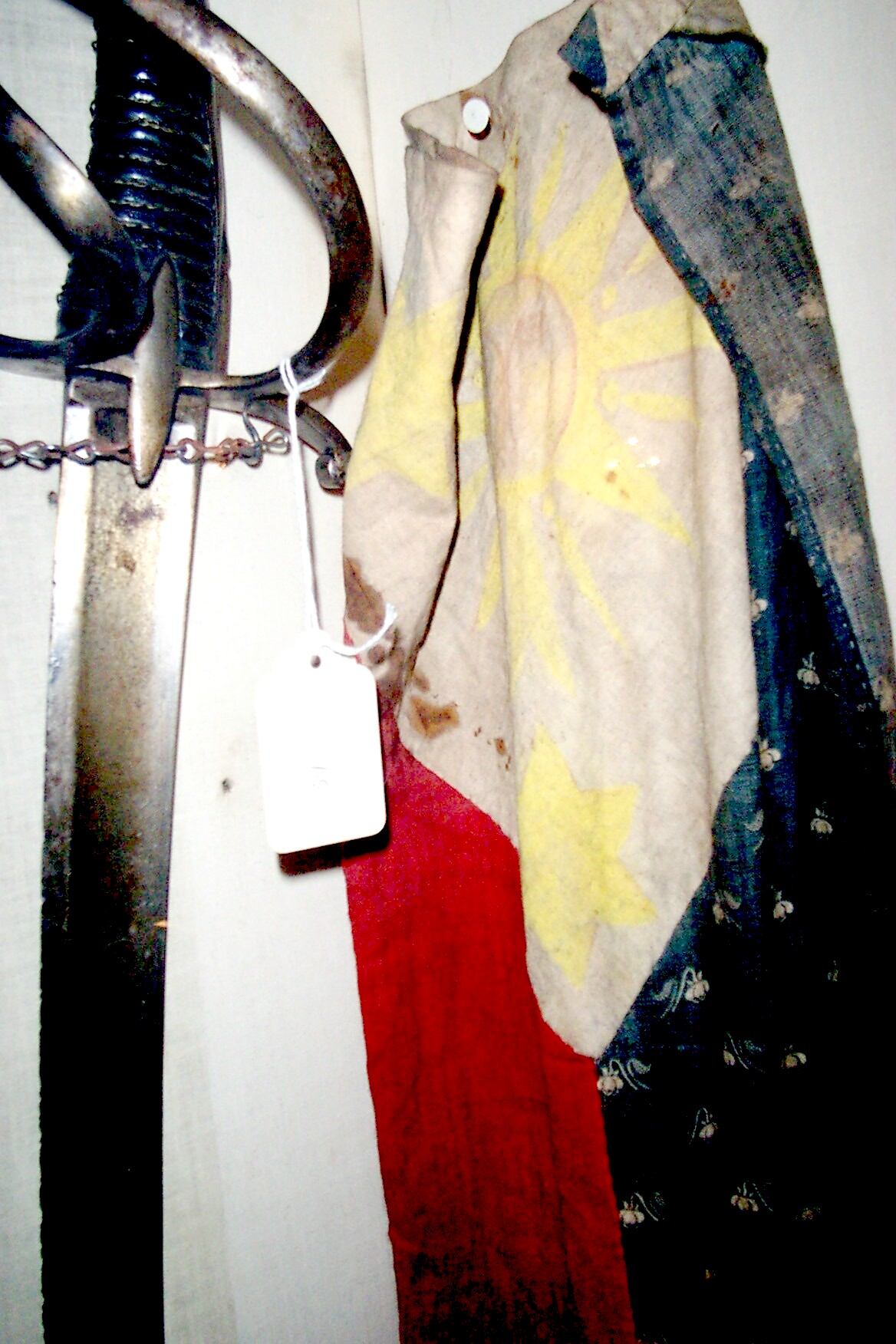
Assistance is requested regarding a very old hand made Philippine flag that was shown to me privately several weeks ago. I probably would not have paid much attention to this old flag except my curiosity was aroused when I saw a sword owned by a Captain Rheinhold Richter of the 1st California Volunteer Infantry in the same collection. US Military records reveal that the sword was presented to a Lieutenant Rheinhold Richter by Battery C Artillery Regiment on 12/4/1893. Captain Rheinhold Richter was the first American Officer killed in the Philippines on August 4, 1898
According to Mr. Peter Fries who was employed in 1980 as the secretary of the trustees of the Veterans War Memorial Building, the flag I saw was given to Ted Roosevelt by Commodore Dewey and it became a part of a presidential collection that was first exhibited at the Worlds Fair and at the Panama Exposition in San Francisco.
The flag is made of silk or satin with a white triangle containing a sunburst of golden rays at the center, there is a star at each angle of the triangle, an upper stripe of dark blue, and a lower stripe of red. The face of the cloth is glossy but dull on the other side. This flag must be of extreme historical importance or it wouldn't be
included in this collection of US Military trophies.
I am aware of the controversy regarding the original Philippine flag and my concern is to preserve this aging flag should it prove to be authentic. I will appreciate feed backs from credible research organizations or individuals.
I am the person to contact regarding this inquiry, at rudyasercion [at] yahoo.com.
Rudy Asercion, 16 August 2004
National Coat of Arms
![[Coat of arms of Philippines]](http://flagspot.net/images/p/ph%29.png)
Background information is available on the Senate website.
"The Coat of Arms of the Republic, approved by Commonwealth Act No. 731, was the beginning of heraldic tradition in the Philippines where before there was none. What followed thereafter was the implementation of Executive Order No. 310 s. 1940 issued by then President Manuel L. Quezon creating the Philippine Heraldry Committee to make studies and recommend the adoption of coat of arms for the different government offices, semi-government corporations, provinces and chartered cities. President Quezon, in issuing E.O. No. 310, created the Philippine Heraldry Committee to make studies and recommend ways and means for the adoption of coat of arms of the different government institutions, set the pattern of symbols to be used reflecting physical or geographical considerations, significant emblazonry as well as supporting documents, orders or grants. To ensure that the coats of arms of the Republic are manifestations of the ideas and ideals of the offices or the people concerned, the Philippine Heraldry Committee, from the year of its reconstitution on January 7, 1946 to June 30, 1973, encouraged all concerned to submit the designs and the symbolism of the design of their coat of arms limiting the work of the Heraldry Committee to putting in the correct heraldic phraseology the designs submitted for an office, province or city. The Heraldry Committee through the technical staff prepared the final design with the heraldic description for the approval of the President of the Philippines. By coursing through the Office of the President the approval of all representative coats of arms, the duplication of particular symbols was avoided by various offices since most of these coats of arms were used for corporate or administrative seals to authenticate public documents.
[...]
The [...] Coat of Arms of the Republic [...] was approved on July 15, 1950.
[...]
As a symbol of the State, the coat of arms of the Republic represents three historical phases — Philippines, Spanish and American. The Philippine symbols are shown in the chief part of the coat of arms. These are the three mullets (5-pointed stars) and the eight-rayed Philippine Sun “in rayonnet” on the heraldic point of honor. The three five-pointed stars indicate the solidarity of Luzon, Visayas and Mindanao. The eight rays of the sun represent the provinces of Manila, Bulacan, Pampanga, Nueva Ecija, Morong, Laguna, Batangas and Cavite, which were declared under Martial Law by a Decree of the Spanish government during the revolution of 1896. The three stars and the sun are one and inseparable. The national colors are preserved in tinctures of white (chief and heraldic points of honor); red (dexter base) and blue (sinister base). The Spanish symbol is found on the dexter base (right side) of the seal. The Lion Rampant was taken from the Royal Spanish Flag used by Legazpi in the actual occupation and colonization of the islands. The American symbol is the American bald-headed eagle displayed on the sinister base (left side) looking towards the dexter side, which is the peace side. The eagle, often called the King of Birds, has been considered throughout the ages as the symbol of supreme authority and power [...]."
Ivan Sache, 22 February 2009
Flag Monument
A statue honouring the Philippine national flag (only the flag is painted in full colour) can be seen at http://travel.webshots.com/photo/2915249710028972814LKDiRc. Titled “Three Ladies and the First Philippine Flag, University of the Philippines, Quezon City, Philippi”, this Webshot photo was uploaded by “maryan54” on 18 Sep 2008.Further comments: “UP Diliman, Quezon City, Philippines - The Philippine flag was designed by Emilio Aguinaldo (1st President of the Republic) who commissioned 3 ladies to sew the first flag in Hong Kong: Marcela and Lorenza de Agoncillo (mother and daughter) together with Josefina Herbosa de Natividad (niece of Jose Rizal, our National Hero).”
Article from : http://flagspot.net/flags/ph.htmlhttp://flagspot.net/flags/ph.html


![[Flag of Philippines]](http://flagspot.net/images/p/ph-two.gif)
![[Flag of Philippines]](http://flagspot.net/images/p/ph-evol3.gif)
![[Flag of Philippines]](http://flagspot.net/images/p/ph-evol4.gif)
![[Flag of Philippines]](http://flagspot.net/images/p/ph-evol5.gif)
![[Flag of Philippines]](http://flagspot.net/images/p/ph-evol6.gif)
![[Flag of Philippines]](http://flagspot.net/images/p/ph-evol7.gif)
![[Flag of Philippines]](http://flagspot.net/images/p/ph-magd1.gif)
![[Flag of Katipunan]](http://flagspot.net/images/p/ph-evol8.gif)
![[Flag of Katipunan]](http://flagspot.net/images/p/ph%5Ecatip.gif)
![[Tagal Flag]](http://flagspot.net/images/p/ph%21novel.gif)
![[Flag of Philippines]](http://flagspot.net/images/p/ph-evol9.gif)